Senin, 06 Desember 2021

Dark Living Room

Dark Living Room

Dark interior design is everywhere right now, we can't scroll through Instagram without seeing someone gloriously dramatic space. And it's easy to see why: dark schemes are a great backdrop for furniture, whether neutral or bold in color and design; dark decorating schemes make rooms feel cozy and inviting – even in larger spaces; and they're practical too, hiding all manner of sins, from sticky fingerprints to irregularities in walls.

And while there is no denying that we will continue to be obsessed with light, airy interiors, a blank white wall just doesn't fill us with the same glee it once did. So, we think the time has come to move away from light-centered interiors to something a little more… dark.

From gothic bathrooms and atmospheric living rooms to bold kitchens and moody hallways, we say ditch all-white everything and join the inky revolution with these inspiring dark interior designs…

If you love these dramatic looks check out our black living room ideas feature next.

1. Add drama with black tiles

Fired Earth glossy black metro tiles

(Image credit: Fired Earth)

How delicious are these glossy black metro tiles? More dramatic than paint or wallpaper, bold, dark tiles add heaps of glamour but are still in keeping with that moodier vibe. If this look is a bit too Tim Burton for you, try using black tiles over a smaller surface area like a kitchen splashback, the walls of a shower or around a fireplace.

Love this dramatic space? Check out of full gallery of black bathrooms.

2. Add warmth to dark interior design with earthy tones
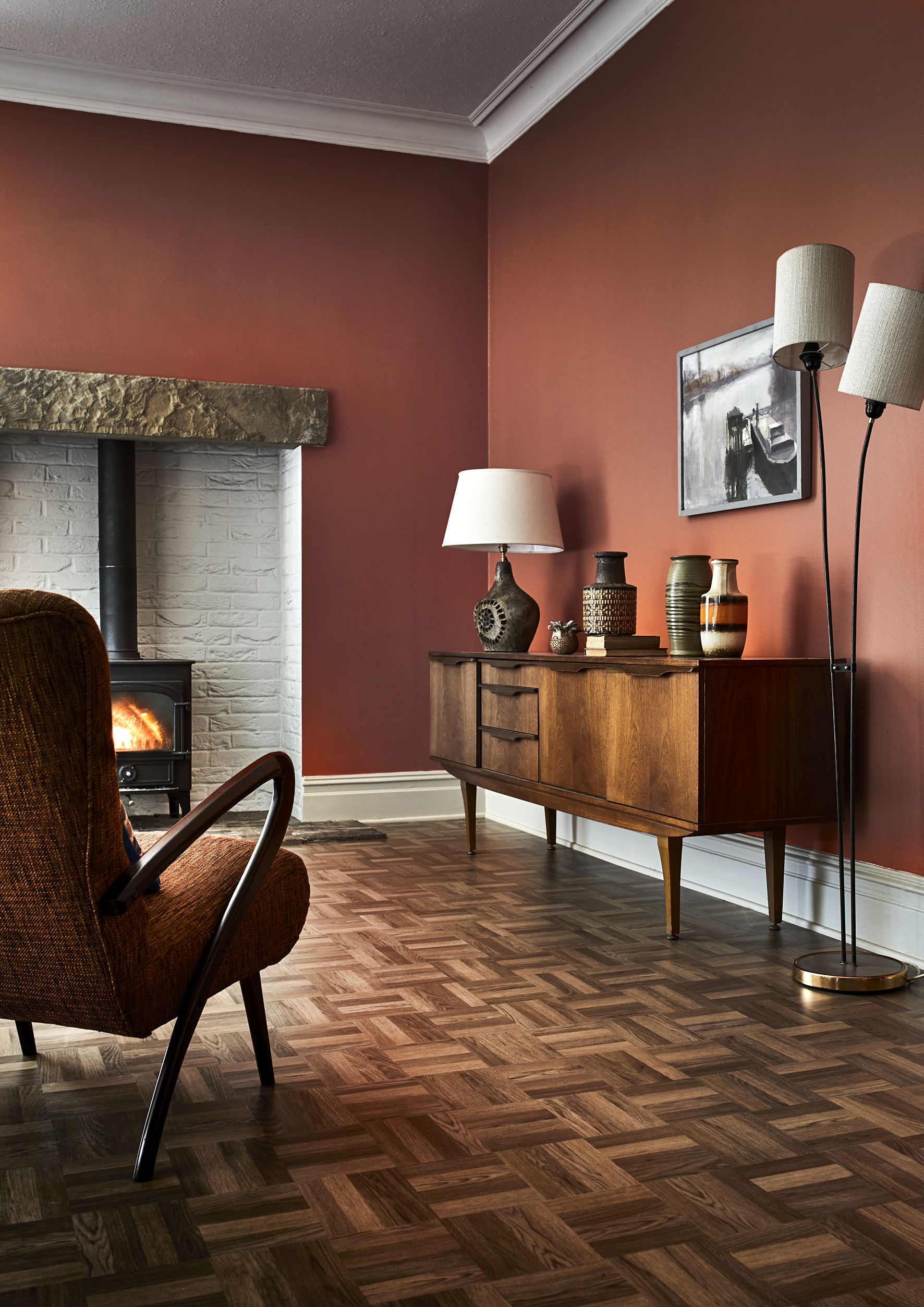
Mid-century modern inspired living room

(Image credit: CarpetRight)

Dark interiors designs aren't all about greys, blacks and blues – deep rusty oranges and reds are also fair game. Try combining a deep orange like Dulux's Tuscan Terracotta with dark wood flooring and Mid-century furniture to re-create this cozy look.

3. Small space? Paint the ceiling

We have a tendency to think that painting a ceiling white will make it look higher, and as a result make the room look bigger. But painting a ceiling the same dark hue as your walls means that you can't actually read where the walls end and the ceiling begins, creating the illusion that the ceilings are in fact much, much higher. Genius, no?

Top tip: If your room is narrow, paint the two shortest walls a slightly lighter shade than the longer walls, and keep the floor and ceiling neutral to correct the room's proportions.

4. Pick accessories in contrasting colours
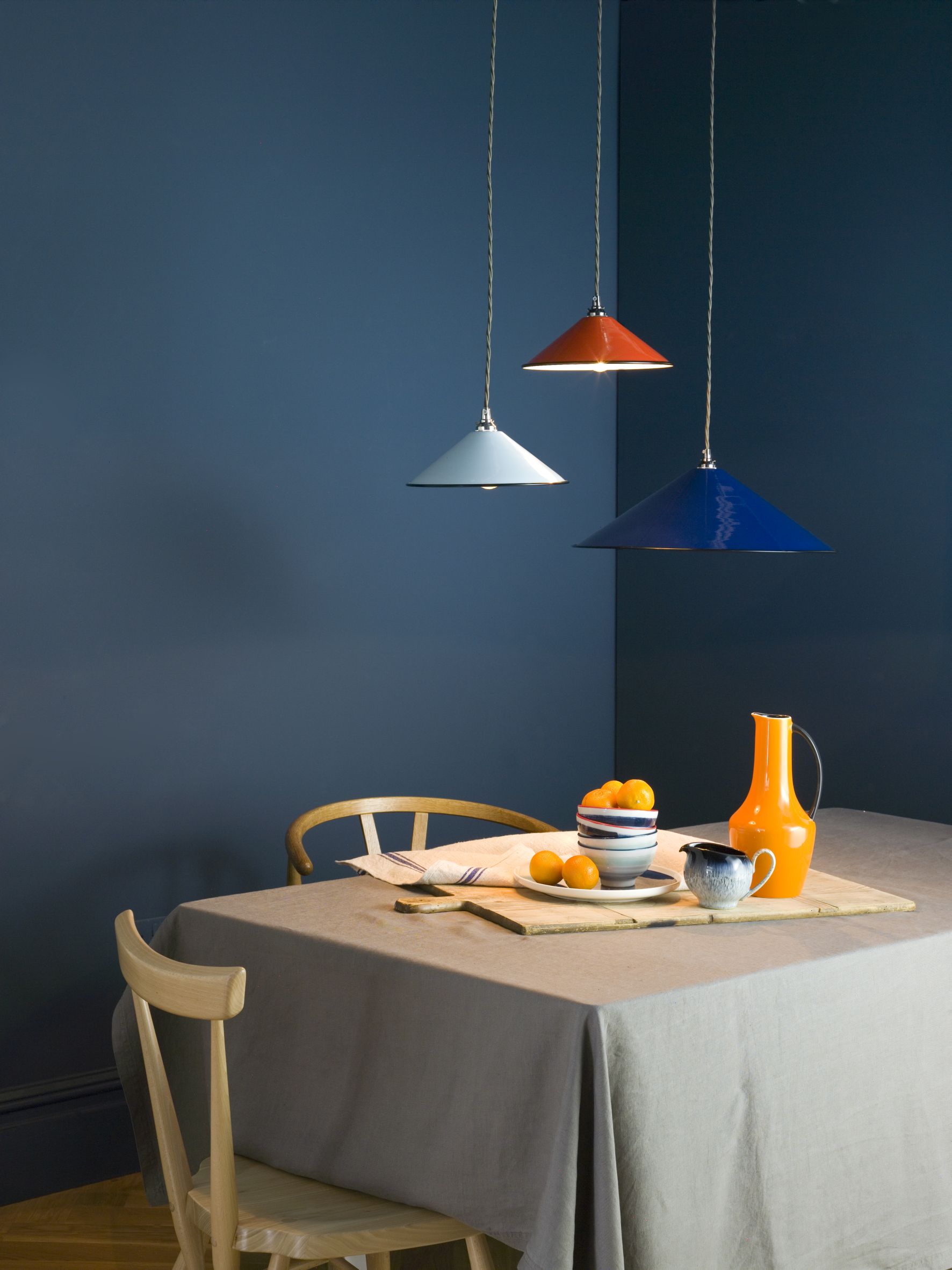
Dark blue dining area with bright light fittings

(Image credit: Pooky)

Another myth about white paint is that it makes other colors' pop'. WRONG. Dark walls accentuate color, making them far more vibrant than a magnolia-blah background. Splashes of bold, bright color – maybe even neon, for the braver of us – will make a strong statement, and cool pastel shades also contrast beautifully with darker tones.
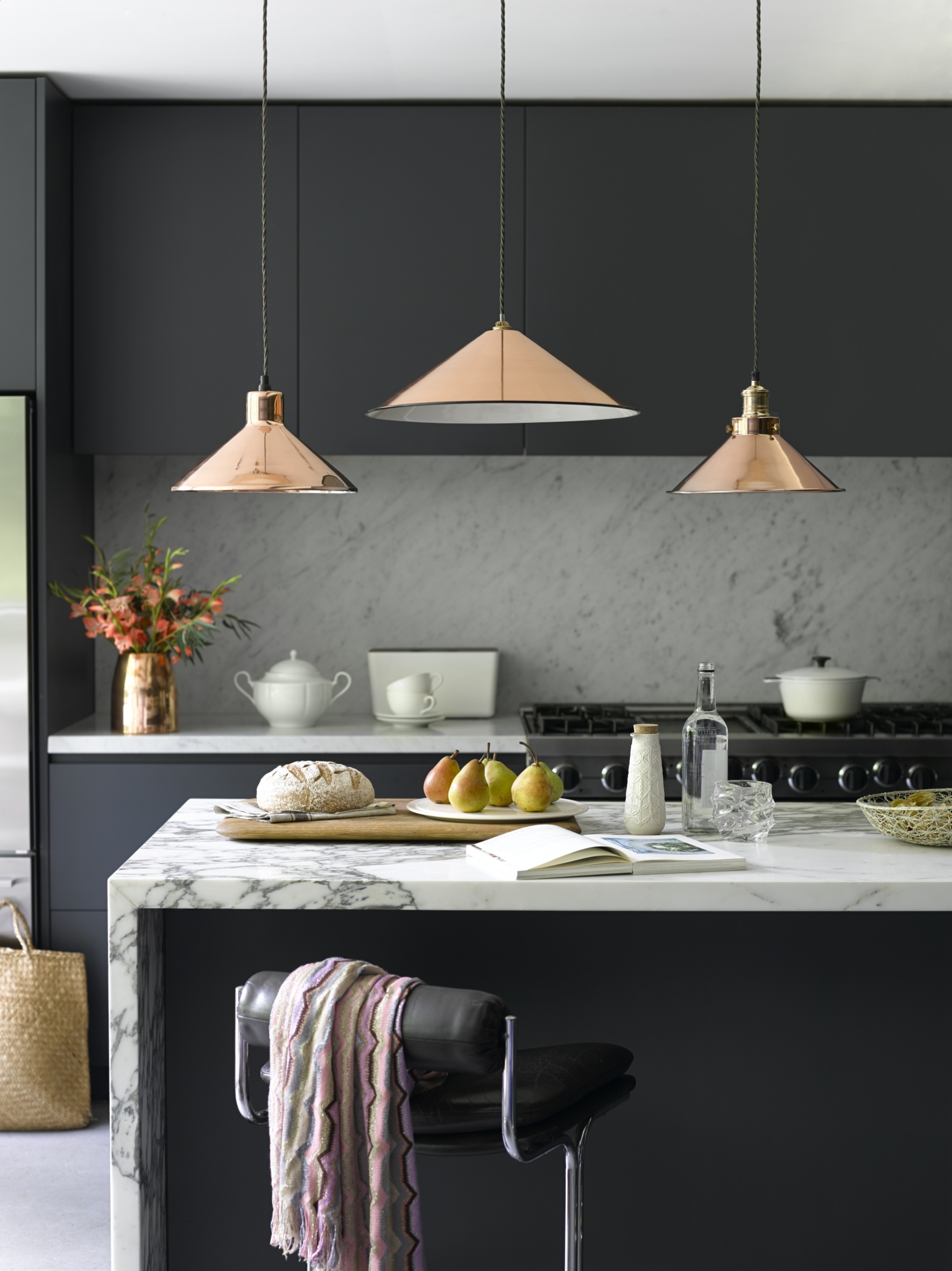
Dark kitchen with cooper lights and accessories

(Image credit: Pooky)

And if vivid colors aren't really your thing, accent metallics look incredible against a dark background, plus the reflective surfaces will help more light bounce around the room.

5. Blend in larger pieces of furniture

This is a brilliant trick if you are working with a smaller space. Painting furniture, especially bigger pieces like wardrobes and bookshelves, the same dark color as the walls can stop a small space from feeling cluttered and keeps the room looking more open.

If you are after a guide to how to paint furniture, check out our step by step.

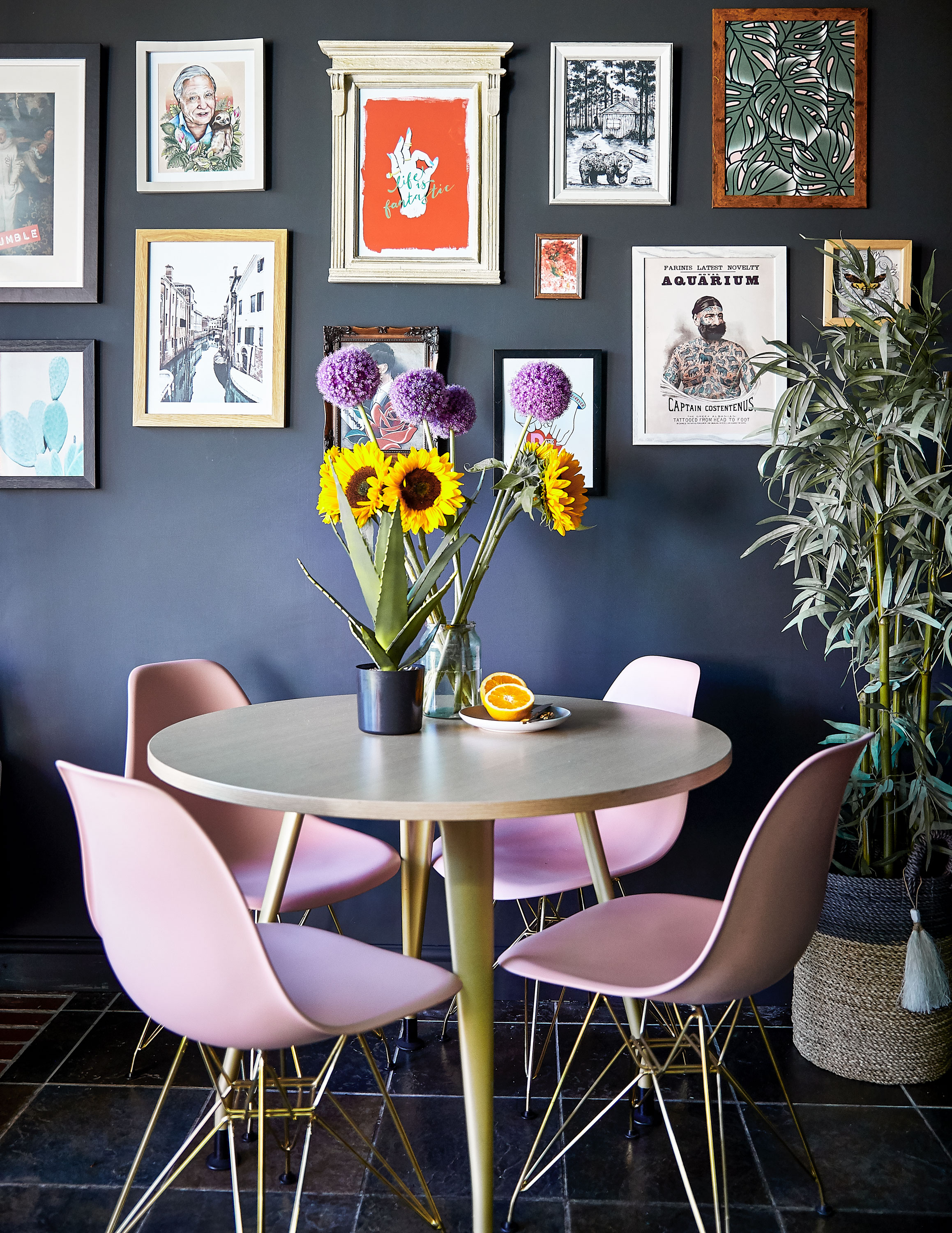
As you are probably aware we love a gallery wall, and there's no denying that they look best against a dark background. Whether you choose photos, artwork or mirrors, breaking up a dark interior with a well-curated display will always make a statement.

7. Get a style hit with dark florals
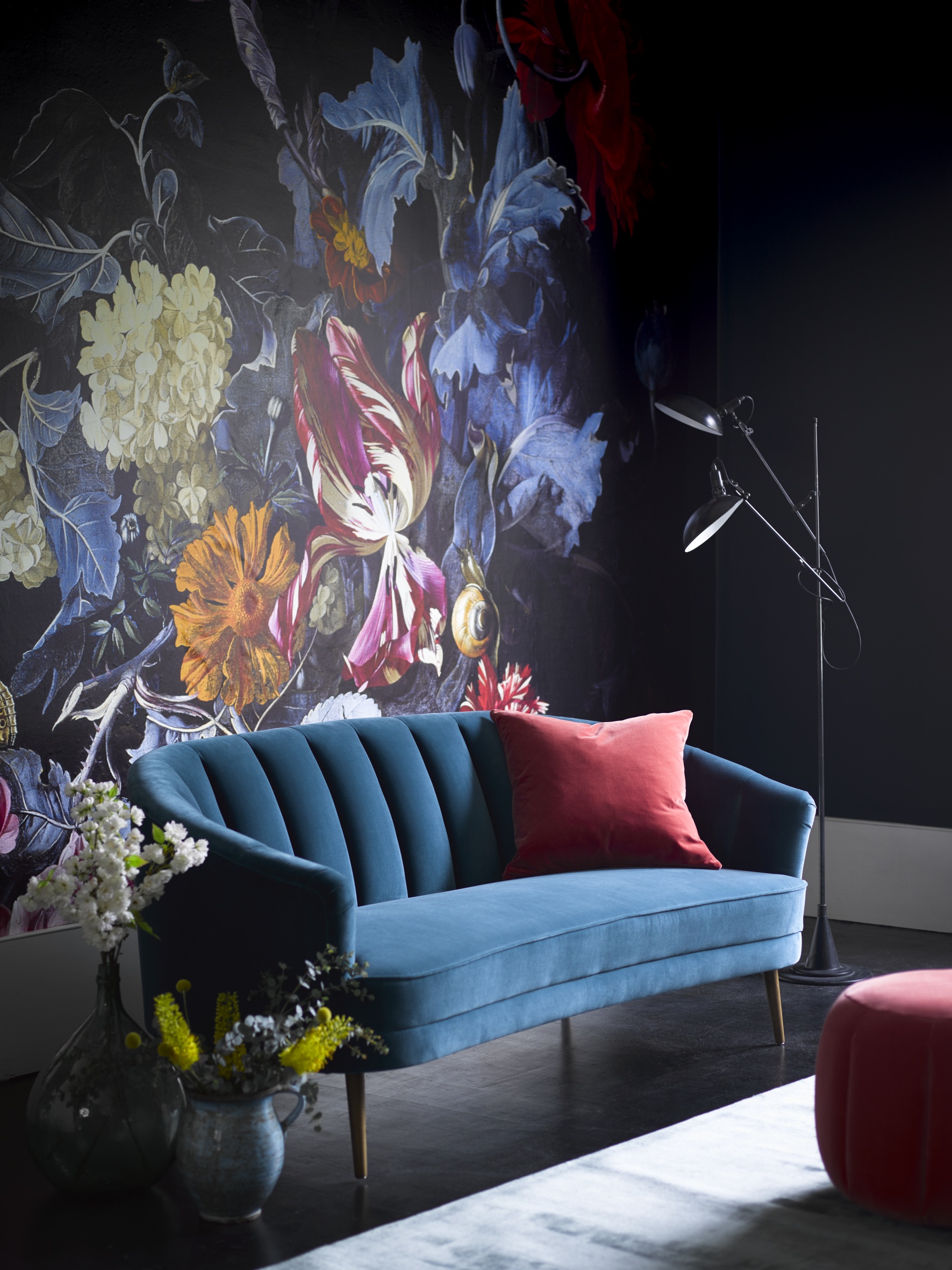
Sofa.com Harper two and a half seat sofa in Deep Turquoise pure cotton matt velvet

(Image credit: Sofa.com)

Florals don't necessarily have to be all about pretty pink roses and whimsical daisy chains, they can be moody too. Our favorite way to incorporate them? A wall mural. A whole room of florals could get a bit psychedelic but we love the sophisticated look of this Dutch Masters-esque wall mural.

8. Make dark interior design work with any style

Scandi-inspired living room by John Lewis

(Image credit: John Lewis)

The beauty of dark interiors is that they can be adapted to work with any style. Yes even Scandi can be taken over to the dark side. Just check out this living room – the pared-back, pale wooden furniture and the neutral hues of the accessories work perfectly with the deep blue feature wall.

Find lots of inspiration for grey living rooms in our gallery.

9. Add depth to a dark room with house plants

Creating a moody interior isn't all about covering walls in dark paint. Copious amounts of house plants can give even the lightest room a dark and atmospheric feel. This gorgeous bathroom should be super bright with its white walls and pale grey, glossy tiles, but the mini jungle going on in there gives it plenty of depth.

10. Keep the lighting warm in dark interiors
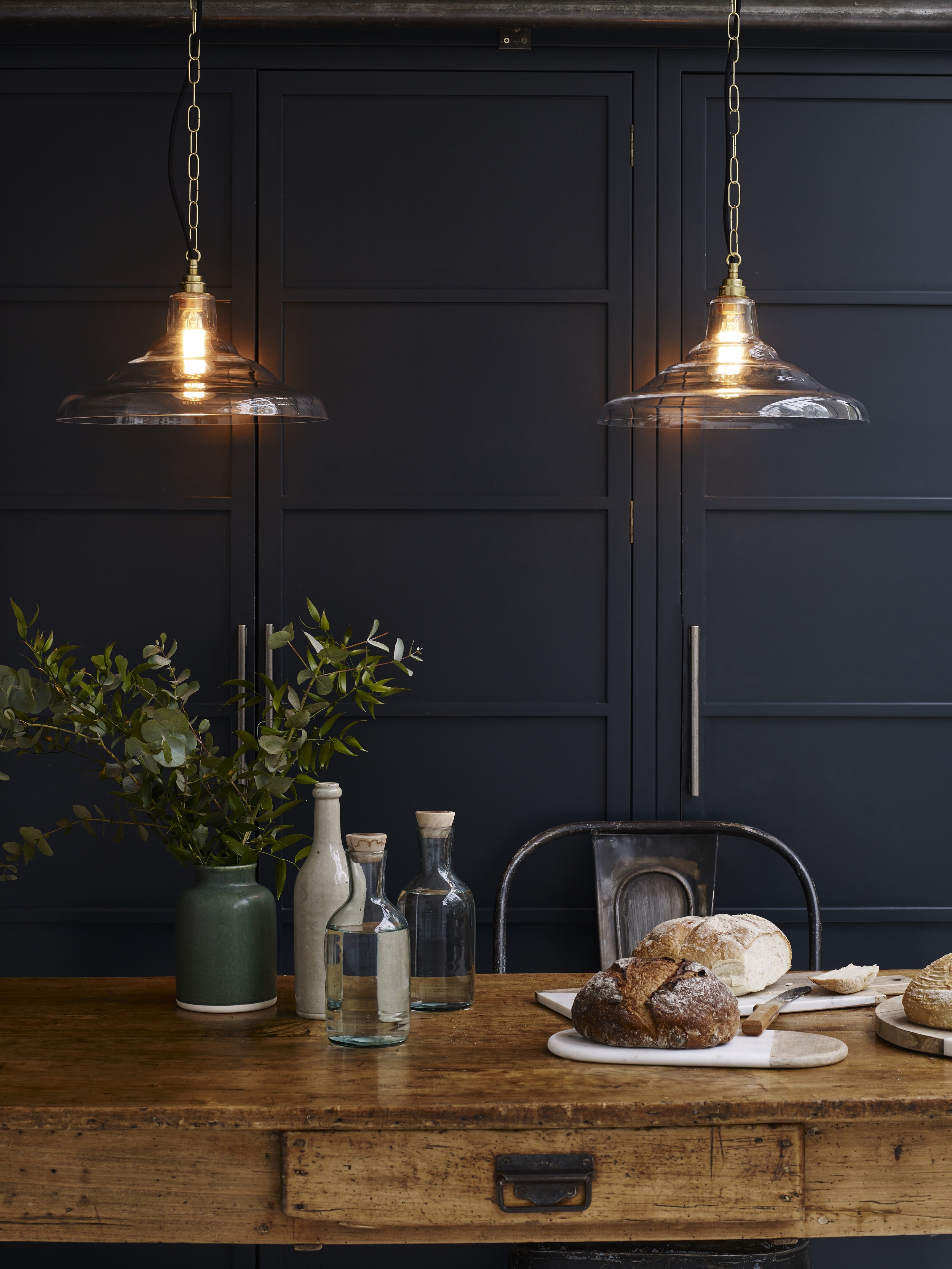
Warm low lighting in a dark decorated kitchen

(Image credit: Davey Lighting )

When it comes to lighting a darkly decorated room, it goes without saying that you should avoid anything too bright. Choose shades that cast a warm light – drum shades lined in gold or copper work best for keeping the light low and luxurious. If you can, have lighting on dimmer switches as this will only enhance the moody, atmospheric feel.

11. Create depth with varied textures

Dark living room with large mirror

(Image credit: Crown)

If you're looking to add depth or soften a dark scheme, consider adding some warmer woody tones. In this room the brown cabinet plus the log pile bring a rustic feel to the dark space that risk being on the colder side because of larger proportions of the space.

A brooding palette with flashes of Art Deco creates drama in the period home of Cat and Dain Maginnis

(Image credit: Dan Duchars/The Contented Nest)

A darker background is going to make whatever you hang on them pop, so be bold in your choices of print for your gallery wall. A gallery wall can also lift a flat dark wall too that might not get much natural light. If you need some inspiration with your gallery wall ideas check out our full feature.

13. Go for a dark window treatment
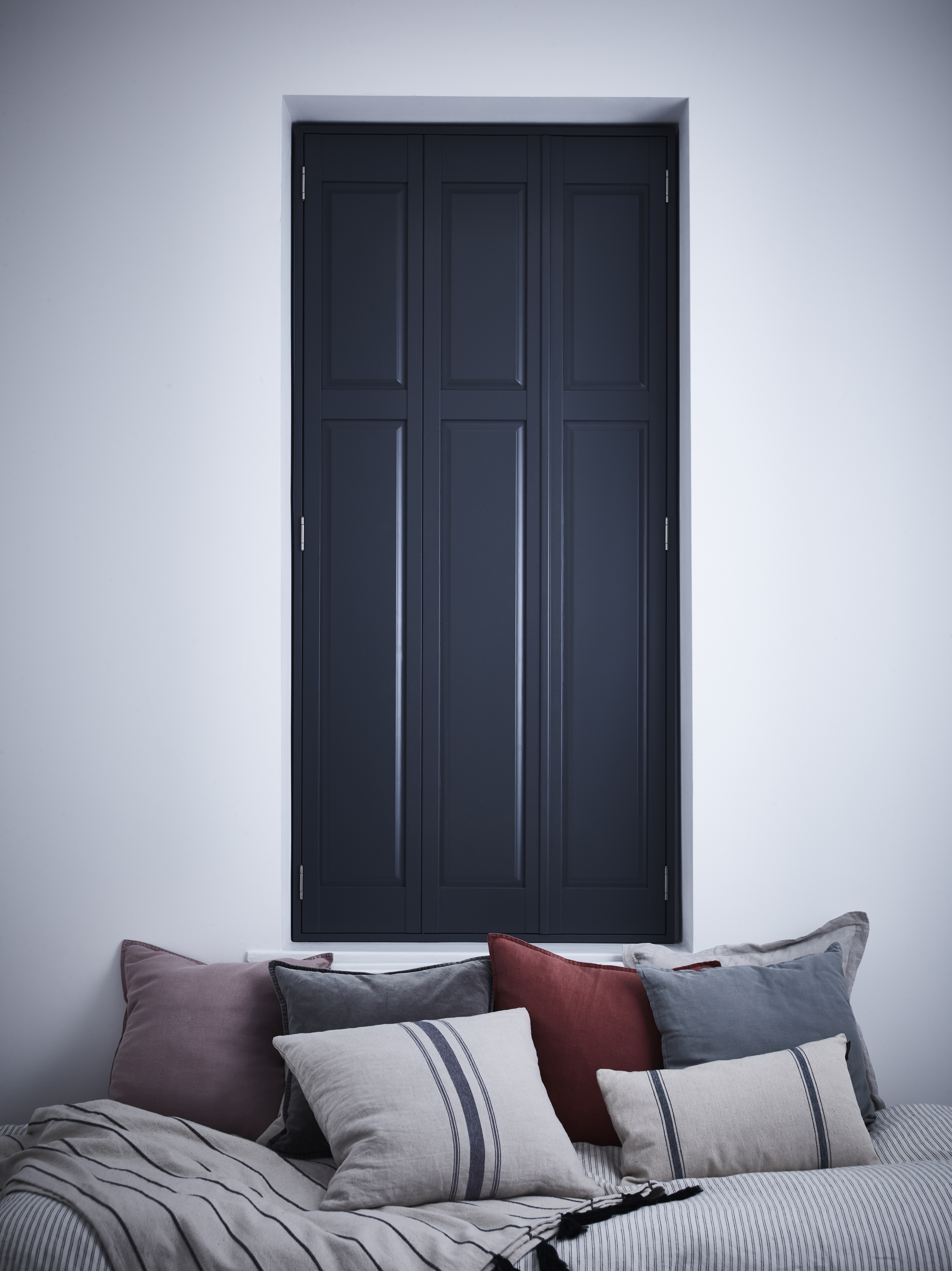
(Image credit: Shutterly Fabulous)

If you want to dabble with the dark side but the idea of painting your walls in anything but white brings you out in a cold sweat, pick a darker color for your window treatments instead. Some dark, heavy velvet curtains can still add that gothic feel or choose some shutters in an on-trend charcoal which can then be paired with more muted, softer shades.

14. Work complementary dark shades into your scheme for a luxe finish
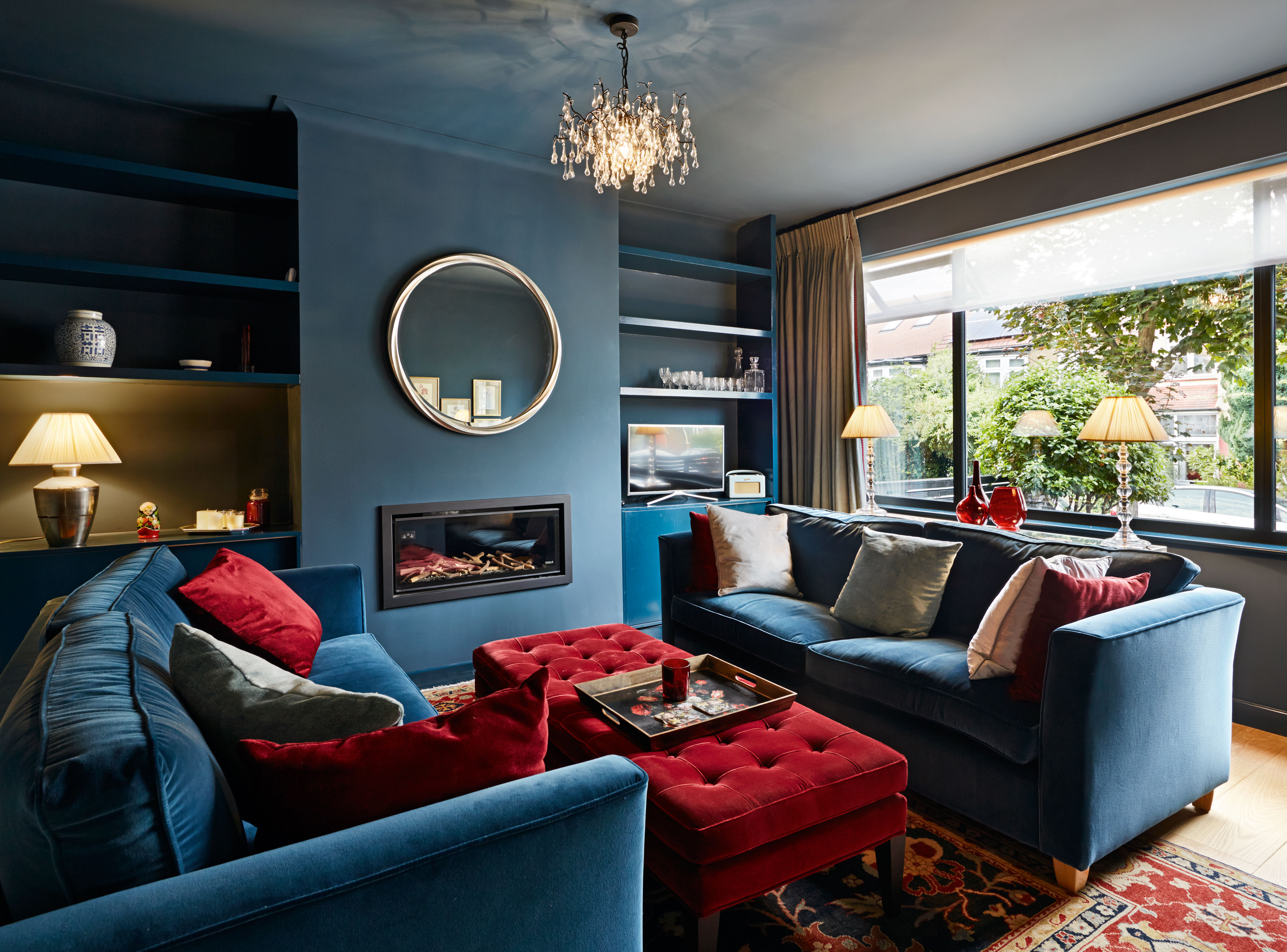
living room with deep blue inky scheme and other deeo red accents by mulroy architects

(Image credit: Joakim Boren (Mulroy Architects))

If you're considering using dark, inky shades to create a luxe finish, consider working another equally rich, complementary shade into your scheme – red is a great example – to balance out the space and add interest.

Opting for a deep-red Persian rug, as well as a gorgeous velvet ottoman and accent cushions is effective in breaking up an otherwise cohesive blue scheme. The use of complementary, inky shades also gives the space a rich, luxe feel.

15. Choose a richer color palette instead
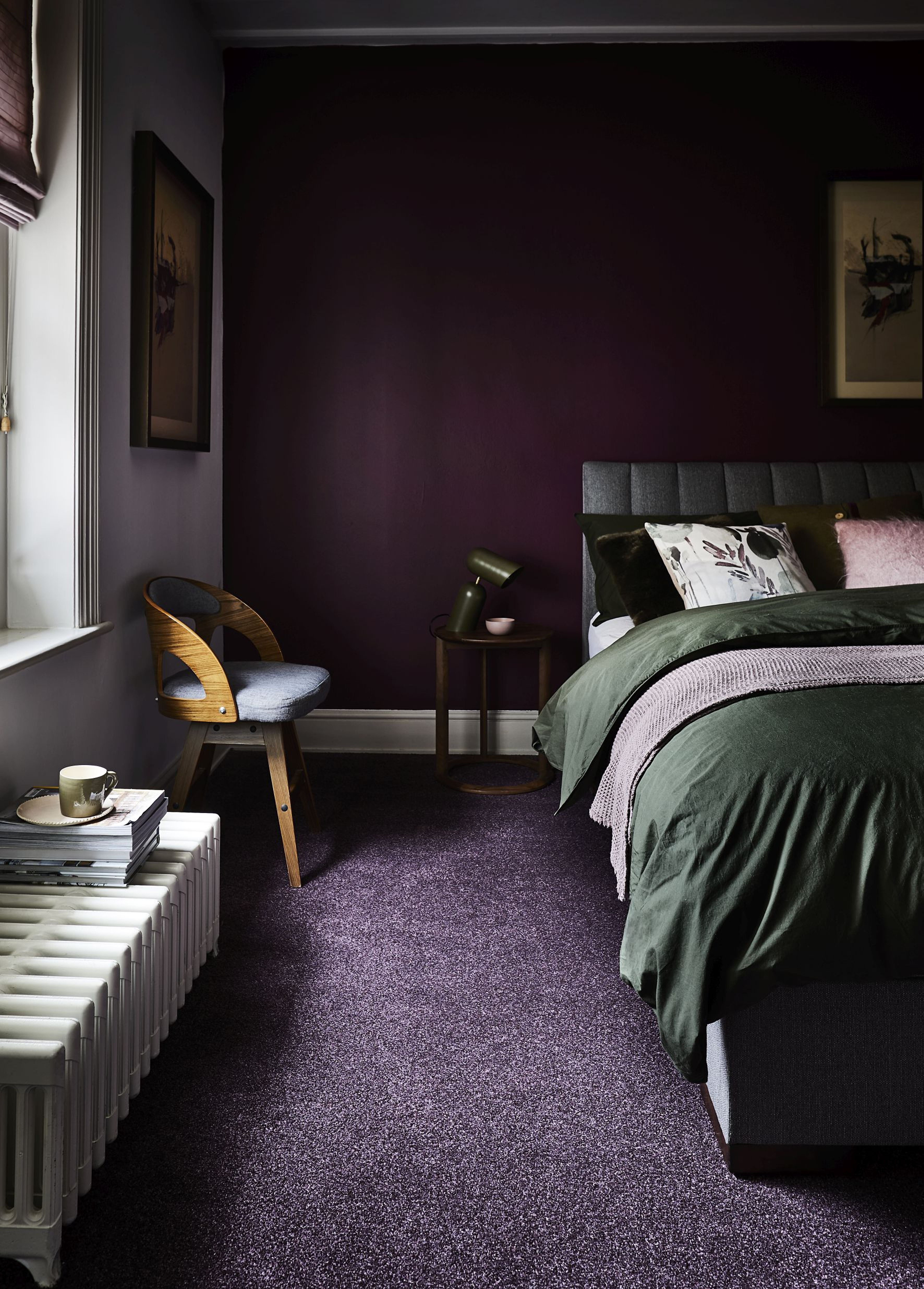
Carpetright Albion Twist Carpet in Mulberry

(Image credit: Carpetright)

Nodding to dark interiors doesn't have to be all about the cool greys and crisp blacks, deep plum shades add just as much drama but give a warmer, cosier feel. Try painting one wall in a deep, rich shade (something like Dulux's Mulberry Burst would work perfectly) and choosing a matching carpet to really enhance that sense of cocooning warmth and comfort.

16. Create a dramatic entrance to your home
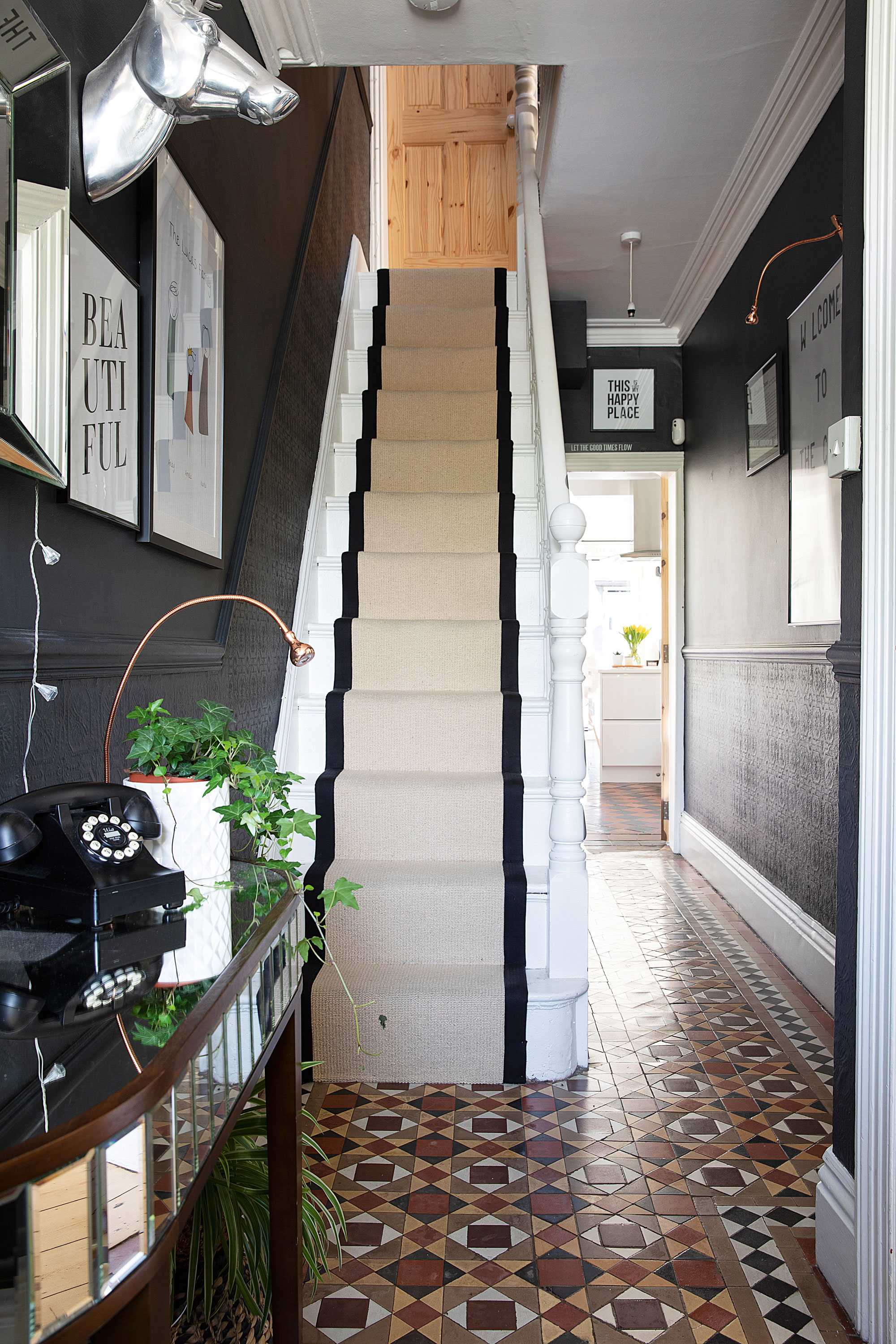
To celebrate the original features of their Victorian terrace, Karla and Andy have created a modern family home with plenty of period character

(Image credit: Katie Lee)

You can't go wrong with a black and white hallway ideas – it's simple and elegant. With a dark color scheme in a hallway, just make sure you add in plenty of lighter hues so the space doesn't feel too gloomy. We like how in this hallways the ceiling and the stairs bring that freshness and the earthy-toned floor tiles warm up the room.

Dark Living Room

Source: https://www.realhomes.com/completed-projects/dark-decorating-ideas

Share:

Interior Design For Living Room Ideas

Interior Design For Living Room Ideas

Small living rooms can feel at the very least, confining. You can make significant improvements to a living room that brings color, taste, and practical storage to even the smallest spaces. Who says you have to be tame? Your creative expression can go wild in a small living room. Striking pieces and rearranging the room can have a large effect on how you use and interact with your small space.

Make use of vertical space

If you can't go wide, go up. Use your walls or vertical space for storage, art, and accent pieces. Walls are untapped space in a small living room for creative expression and practical space utilization. Everything from furniture to statuettes can adorn your walls. Don't be afraid to use bold pieces that showcase your design aesthetic and personal style.

Go light and bright to open up your living space

Dark colors will indeed close a space. By keeping the walls and decor of a small space white or light colors, you give the perception of more room. In a small area, make the most of natural light by using minimal window coverings and allowing light to fill the space.

Stay neutral with added pops of color

Let your living room be your canvas. The coolest thing about neutral colors is that they let bright accent pieces and furniture pop. Keep the room colored in a neutral palette, while adding pops of color. This can range from icy blues to burnt oranges. The choice is yours.

loft room bright couch

asbe / Getty Images

Go long and linear

Ever heard that saying about wearing vertical stripes? Just as vertical stripes on your body create the illusion of height, vertical lines on walls create the illusion of higher ceilings. The key to making the most of a small space is accenting its features. After adding vertical accents through paint or decals, avoid cluttering the space. Bare walls augment the vertical effect.

Functional green home office and living room combined

KatarzynaBialasiewicz / Getty Images

Shelving is your friend

When decorating a small living room, be practical. There's no room for hope chests or other items that take up precious floor real estate. Adding shelving and other wall-based storage solutions keeps the flow and openness of the room. As a bonus, you have a cute place to keep your stuff.

mid-century shelving

KatarzynaBialasiewicz / Getty Images

Leverage the space behind your couch

No space should go to waste. A mid-century credenza can add a tasteful accent to a room that doubles as storage for private items. If backed against a wall, this is the place to showcase your artwork. The area can also be used for partial room dividers or screens.

art and credenza behind couch

Bulgac / Getty Images

Create an accent wall

What are your eyes drawn to first in your living room? An accent wall breaks up the space with color or texture. By adding an accent wall, you remove the monotony of bare walls in a small space and give the room a natural centerpiece. Start small with color, or go big with an architectural accent.

wood accent wall

Avdic / Getty Images

Opt for floating furniture

Who's ready to defy gravity? Floating furniture gives a futuristic feel to any room. It's aesthetically, gorgeous and modern. Most importantly, by freeing up floor space, you create the illusion of more space even in the smallest of rooms.

Add life with plants

Let your imagination run wild-- and some houseplants! Any room can be brought to life with plants of all sizes and colors. Bare corners are helped with greenery, as well as empty shelves. Plants filter your air and bring a fresh look to living room decor. In addition, plants make a room look and feel homier.

plants

aldomurillo / Getty Images

Leverage the power of threes

When in doubt, triple it. Add three of a small accent at a time to refine a small living room. The important thing to remember is that your decorating should show thought and intentionality. By adding three of the same thing-- a painting, a sculpture, a plant-- your care for your small space shines through.

Scandinavian style living and dining room.

1172217300 / Getty Images

Interior Design For Living Room Ideas

Source: https://facty.com/network/diy/go-big-on-these-design-ideas-for-your-small-living-room/

Share:

Black And Cream Living Room Curtains

Black And Cream Living Room Curtains

Living Room Decorating Ideas

iStock

The living room is one of the most important areas in your house for a great hosting experience. It's likely you and your guests will spend countless hours in this room, discussing and entertaining.

Decorating your living room properly will deliver deeply satisfying living for your leisure time. To get there, however, you must pay attention to all of the following areas:

1. the colors that you select

2. material and quality of seats and furniture

3. wall decorations and art

4. lighting and light fixtures

Below we show you some great ideas for decorating your living room.

The Best Colors for Your Living Room

One area that will have a disproportionate impact on the mood of your living room is the color you choose for the walls. While you can install wallpaper to change the look of certain walls, there are areas that wallpaper cannot cover. Getting the wall color right, therefore, gives you the best shot at creating a remarkable effect.

Some of the best color palettes for living rooms include:

1. White - White walls add a touch of class. They are the perfect backdrop for decorating with upscale furniture.

2. Turquoise - This color is great for creating an informal but refined feel. Your kids and family will love the refreshing mood this color creates.

3. Cream - Striking a balance between formal and informal, cream-colored walls create a quiet, soothing effect.

Furniture Choices

With your wall color selection made, you should select furniture that pairs well with the colors you've already chosen. For example, combining white couches with white walls will create resonance in your room design.

Make sure to provide ample seating to avoid crowding. Add multiple sofas, easy chairs and other seats that can accommodate a complete roomful of people, depending on the size of the room.

Furniture like TV stands and tables should generally blend in with the colors of the room and ceiling. There are some natural materials, however, that can work regardless of the colors on the walls. For example, wooden table surfaces look good whether your walls are white, blue or another color.

Lighting Ideas

You can greatly improve the aesthetics of a living room with bright lighting and impressive light fixtures.

To start, you can consider a beautiful chandelier in the center to provide light around the whole room. This central masterpiece ensures adequate lighting throughout the living room while adding an air of elegance.

You can then add to the light sources in the living room with individual lights on tables and around the walls in areas where people will not knock them down.

Carpeting

Consider adding carpeting to your living room to create a comfortable walking area. Carpeting lets you and your guests go barefoot if you choose. The living room almost demands this since you will want to take off your shoes and kick back on occasion. Warm plush carpets provide a good, comfortable surface for this. There are many choices when it comes to carpet size.

If your living room is very large, you can opt for wall-to-wall carpeting. On the other hand, if it's smaller, you can add just an area rug in the place where you will sit. For example, you can have a rug around the sitting and TV area where your kids will play.

The advantage of area rugs over wall to wall carpeting is, mainly, lower costs and ease of replacement. You can completely change the area rug and create a new aesthetic in a fraction of the time it would take to begin installing new wall-to-wall carpeting.

Art Ideas for Your Living Room

Many homeowners like to have some wall art in their living room. If your living room is spacious, it can accommodate a good-sized piece of art mounted alongside one wall. In some instances, you can consider multiple art pieces. Invariably, tasteful art adds to the sophistication of a living room. It adds an interesting item that sparks many conversations from impressed guests.

Selecting art is an opportunity to express your unique personality. If you are fairly conservative, you can select some classical type pieces that portray a quiet life. If you are more adventurous, you can experiment with a post-modern impressionist piece that others might consider risky. It's your space, and so feel free to decorate it to express who you are.

Black And Cream Living Room Curtains

Source: https://www.life123.com/home-garden/decor/living-room-decorating-ideas?utm_content=params%3Ao%3D740009%26ad%3DdirN%26qo%3DserpIndex

Share:

Minggu, 05 Desember 2021

Nordic Living By Biehl

Nordic Living By Biehl

Norid Living by Biehl, interiors and lifestyle shop in Bruntsfield, Edinburgh

Their new lifestyle and interiors store, Nordic Living by Biehl, is the latest addition to Bruntsfield's independent scene, providing an inspiring space to shop and browse since its launch last month.

Arranged over two floors, the newly-refurbished shop is full of carefully selected pieces, from high-end chairs and classic lighting to candle holders and jewellery, all displayed alongside some striking contemporary art.

Proving that Nordic style doesn't only mean neutral and minimalist, there are plenty of colourful and tactile soft furnishings, including handmade jewel-bright velvet cushions.

Sign up to our daily newsletter

The i newsletter cut through the noise

"Although we've only recently moved to Edinburgh from Copenhagen, we have family in the city and are happy to be beginning a new chapter of our lives here," says Mogens. "We've chosen some of our favourite pieces to stock in Nordic Living, along with vintage ceramics, artwork and furniture. These look incredible in Edinburgh's period houses and flats, just as they do in the newest city developments."

While a set of two champagne coupes from the Ferm Living 'Ripple' glassware range could be yours for £29, the starting price for a House of Finn Juhl '46 Sofa' is £6,850.

With no background in retail, the venture has been built around the couple's shared passion for outstanding Nordic art and design.

Sofie adds: "This is the culmination of many years' planning and it's wonderful to see our dream becoming a reality. Bruntsfield is a perfect location for us; a vibrant neighbourhood with some thriving independent stores, restaurants and bars."

n Nordic Living by Biehl, 185 Bruntsfield Place, 07378 400848, mynordicliving.co.uk

Nordic Living By Biehl

Source: https://www.edinburghnews.scotsman.com/arts-and-culture/danes-making-their-mark-edinburgh-minimal-effect-581847

Share:

Living In Moscow 2017

Living In Moscow 2017

Most foreigners who have spent extended periods of time in Russia can recall advice given to them before their arrival. For government officials, it comes as an institutionalized briefing from their security services. For journalists, scholars, and students, it often comes as wisdom passed down from previous generations of Russia watchers.

For both, the mantra is the same: assume you are being watched.

In modern Moscow, this advice can be easy to forget. The city is a bustling cosmopolitan metropolis like any other. But when Briton Jonathan Haslam first visited as part of a six-month graduate exchange in 1977, the Russian capital was another world. As a foreigner in a closed society, his very presence and interest in the Soviet Union aroused deep suspicion.

"The assumption was that foreigners were spies," he recalls. This was implicit in the way the Soviets handled visitors like Haslam. There were strict restrictions on where foreigners could live, and the authorities monitored their daily life – both covertly and overtly.

"Their aim was largely to deter you, to give you the impression of total coverage," Haslam says.

That was the Cold War. Much has changed since 1977, but the spectre of unwanted government attention still hangs over the ranks of Moscow's foreign population to this day — as recent allegations that Russia may have blackmail on U.S. President-elect Donald Trump show.

But much like the unsubstantiated Trump allegations, many cases of surveillance remain difficult or impossible to prove. State-sponsored snooping is real, but perceptions greatly outpace reality. The conflict adds a degree of paranoia to daily life in Moscow.

Back in the USSR

From a historical perspective, foreigners are not wrong to fear surveillance. The Soviets were unparalleled masters of the art, argues Haslam, now a historian at the Institute for Advanced Study in Princeton, New Jersey and the author of Near and Distant Neighbors: A New History of Soviet Intelligence, a recent book on the subject.

"They had a vast number of people to call upon for following foreigners, something Western services could not match," he says. "Any girl you went out with would be questioned after your meeting, and then obliged to report on you. Most tour guides were just students on holiday jobs, and they were really there to report on any unusual behavior."

In Haslam's time, students from capitalist nations were confined to the first six floors of an Academy of Science's hotel, which were heavily monitored. Soviet authorities did not always go to great lengths to conceal their efforts.

At the hotel, cleaning staff would regularly sift through papers left by students on their desks. Rooms were obviously bugged. Once, when Haslam broke his morning routine to retrieve a forgotten item from the room, he walked in to find the housekeeper perched atop a stool, talking to a fire alarm on the ceiling.

The fire alarm, it seems, was wired to a central nervous system of surveillance tech hidden away on one of the hotel's 12 floors. That floor was inaccessible from the main elevator, but Haslam says he once stumbled upon the entrance while exploring the back stairwell. An employee had left the door wide open, and Haslam decided to have a peek. Inside, he discovered a room filled with banks of tape recorders.

  				"Blabbing helps the enemy!" This Soviet poster from the mid-1950s reflected the emerging atmosphere of distrust between the Soviet Union and the West,
"Blabbing helps the enemy!" This Soviet poster from the mid-1950s reflected the emerging atmosphere of distrust between the Soviet Union and the West,

New Surveillance, New Russia

That chance encounter with an open door offered Haslam a glimpse behind the curtains of Soviet surveillance. But it was just one facet of a broad-spectrum effort that Katy Pearce, an expert on media and surveillance in the former USSR, recently described in the Washington Post as a "tedious, costly analogue process involving phone tapping, stakeouts, following people, and lots of photography and videotaping."

The Soviet collapse in 1991, however, "democratized surveillance," Pearce argues.

What was once the exclusive forte of a monolithic state apparatus became the bread-and-butter of thousands of former KGB agents, sent out into the cold without work. To make ends meet, they began plying their trade in the private sector, working for Russia's emerging class of oligarchs. As a result, blackmail came to play an outsized role in the topsy-turvy world of 1990s Russia.

Prominent politicians and businessmen had their phone calls surreptitiously recorded and leaked to the press. Rumor and blackmail became tools of the political trade.

In 1999, Russian President Boris Yeltsin even used a compromising sex tape to take down the prosecutor general, Yury Skuratov, who was investigating him for corruption. The man who orchestrated the operation was none other than Vladimir Putin, who then served as the head of the Federal Security Service (FSB) — a scaled-down remnant of the Soviet KGB.

Such cases bolstered the mythology of surveillance. The Soviet collapse had opened the floodgate, and thousands of foreigners poured into Russia. With high profile surveillance cases proliferating, many foreigners seemed to believe that they, too, were under watch. That was one of the "social oddities" of Moscow life, says Matt Taibbi, an American journalist who worked here in the 1990s and early 2000s.

"Foreigners love to talk about how their phones are tapped," he wrote in a 1997 article published in The eXile, a popular but now-defunct Moscow-based alternative publication. "They like the idea that someone considers them important enough to be worthy of listening to."

In comments emailed to The Moscow Times, Taibbi says that, in his view, 95 percent of expats have nothing to worry about. The only real targets are certain prominent businessmen, diplomats, lawyers, and a few journalists.

Taibbi cites his own experience as an example. Reporters working for The eXile were notorious for outlandish, sometimes tasteless stunts, and muckraking investigative work. Taibbi once published transcripts of a former Kremlin chief of staff's phone calls. The records were obtained, naturally, through surveillance. For his efforts, he says he was never followed and his phones were not tapped.

"I had basically begged to be arrested/surveilled," he says. "[The fact that] I wasn't told me that the ordinary expat has little to fear when it comes to surveillance."

Modern Techniques

Technology has undoubtedly changed surveillance as electronic recording devices (i.e., "bugs") grow smaller or give way to cell phones and other networked devices – offering intelligence services a far more efficient means of tracking their targets. "Everything with bugs has been tried, phones are better," a former U.S. diplomat in Moscow said on a strict condition of anonymity.

The methods may have changed, but surveillance – both real and imagined – persists.

In recent years, the Russian government has used surveillance to bust corrupt officials and keep tabs on opposition figures, at times even infiltrating communications mediums like encrypted messenger applications. Russia has also been accused of taking its efforts abroad, hacking networks in foreign countries — such as the recent allegations that Russia hacked to help Trump win the presidential election.

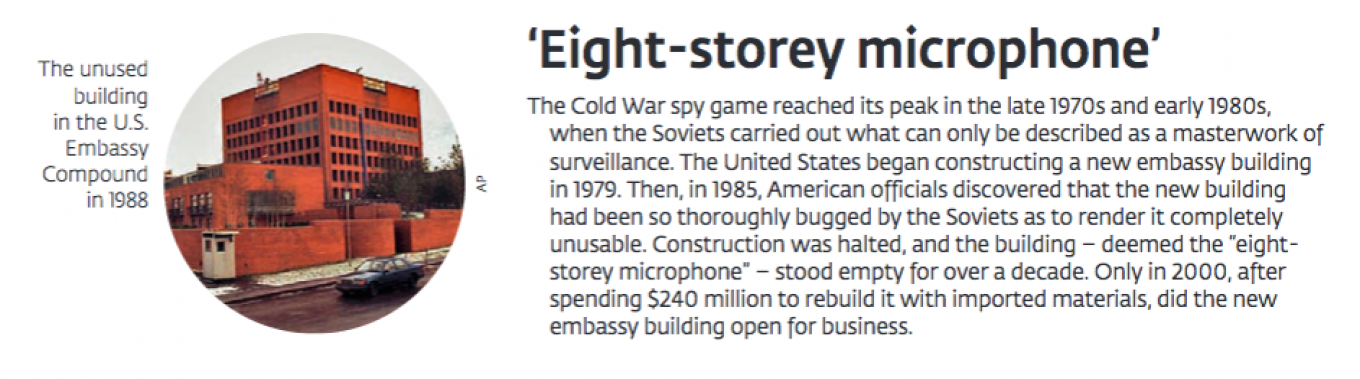
But compared to the Soviet Union, modern Russia is an open society. The average foreigner is not likely to arouse much suspicion. As such, it is diplomats — particularly Americans — who arouse the strongest suspicion among Russian spooks. Even before the recent collapse of U.S.-Russia relations, Russian efforts appear to have become primarily focused on the U.S. Embassy and its staff.

In recent years, the harassment of U.S. diplomats has also increased.

The former U.S. Embassy Moscow official recalled being approached by an officer of Russia's SVR foreign intelligence service after he was transferred from Moscow to Beijing. The SVR agent "pitched" the official while he was applying for a Russian transit visa to spend two days in Moscow en route to Europe.

The pitch began as an innocuous request to retrieve medicine for the Russian in Moscow. The diplomat was told he would be provided with additional instructions upon receiving his visa a week later. This was the red flag, and the American sent his secretary to retrieve the visa in his place. When the Russian, undeterred, emailed the diplomat directly to follow up, the American notified embassy security.

The incident, as told by the former diplomat, sparked a minor spy game in Beijing. Embassy security presented him with a photo line-up of known SVR operatives in Beijing, asking him to identify the official. He was in the line-up. After that, American security officials impersonated the diplomat in a reply email and arranged their own meeting with the Russian, turning the game back on him.

While Americans working at the embassy are natural targets for Russian intelligence, so too are the hundreds of local Russian employees hired by the U.S. to help run the day-to-day at the sprawling embassy compound. One former local employee told The Moscow Times of an incident in which he was actively chased by FSB officers through central Moscow.

Another Russian, who asked to remain anonymous, recalls being warned of intense pressure from the FSB when interviewing for a job with the embassy in 2013. Eight months later, the FSB followed up with the Russian to ask if she received the job. She hadn't. But Russians like her are perhaps one of the embassy's biggest security vulnerabilities.

The former U.S. Embassy official, who worked for one of the American security agencies, estimates that "around 50 percent of the local hires probably have some relationship with the FSB."

"They have access to HR files, medical files, everything. The embassy does not have the resources to track them. And the local employees have details on everything that is happening — who is taking part in delegations, what they are going to be doing, where they will be staying, which rooms they will be staying in, etc. Nothing is secret," the former diplomat says.

The U.S. Embassy declined to comment, describing it as an "internal management" issue.

Both Real and Imagined

Diplomats and embassy workers draw the heaviest attention from Russian intelligence services, but their gaze has been known to occasionally fall upon Western journalists and academics as well — albeit with less intensity. And while Russia targets diplomats to coerce and turn, their interest in journalists and scholars appears to be just as Haslam said of Soviet intelligence: to deter and intimidate.

One Western journalist, on a condition of anonymity, told The Moscow Times that his apartment was broken into following a particularly contentious reporting assignment in September. Nothing was stolen or damaged, but items were overtly rearranged — a tactic that former Guardian correspondent Luke Harding claims he was subjected to regularly during his tenure in Moscow from 2007 to 2011.

Ilan Berman, vice-president of the American Foreign Policy Council think tank in Washington, had a different experience in 2013 while visiting Moscow to meet with local government and civil society officials. Berman, who has written extensively on the demographic demise of Russia and its implications for the future of the Russian state, says his phone's data plan was shut off for a portion of his stay.

Traveling as part of a delegation, Berman says none of the other foreigners traveling with him experienced similar problems. And it wasn't a telecoms glitch or widespread outage — he checked with the company.

"I realized that it was just the FSB's way of saying hello… albeit not a very nice one," Berman says.

Or was it? It is a thought that crosses the minds of many a foreigner when encountering otherwise mundane or random technological glitches. In this way, for every successful infiltration of a foreign phone, there are countless more infiltrations of foreign psyches.

One American resident of Moscow interviewed by The Moscow Times recalled coming home one day to find his television – which he seldom watched – turned on. There was no sign of a break-in, and he wondered if the security services were trying to send him a message. Later, after talking with a friend, he concluded it was caused by a power surge.

Another – an American lawyer with years of experience in Russia – recalled a time when two of his friends received Google alerts informing them that someone in Moscow had tried to enter their accounts. At the time, the American was working for a human rights organization, and often communicated with these friends on Google Chat during working hours. Surveillance or strange coincidence?

Such paranoia is common, fueled both by real instances of surveillance reported in the media and a persistent set of myths and stereotypes about Russians and their espionage capabilities. The recent furor over alleged Russian hacks of the Democratic National Committee, and unsubstantiated accounts of a certain president-elect's sex romps in a high-end Moscow hotel, have mostly just bolstered the mythology.

But not everyone buys into the hype.

"I've always perceived the Russians to simply be very proficient and professional at intelligence work," says journalist Taibbi. "I wouldn't think you would have all these people in the Russian [security services] blabbing about a piece of [compromising material] on a potential American president," he says. "That doesn't scan to me."

Living In Moscow 2017

Source: https://www.themoscowtimes.com/2017/01/19/spy-games-how-the-spectre-of-surveillance-impacts-the-lives-of-moscows-foreigners-a56865

Share:

Living Room Storage Console

Living Room Storage Console

Rose is a full-time freelance writer who frequently writes about education, special education, DIY projects, food, Milwaukee, and more.

How to Decorate a Small Living Room

Every small living space offers design challenges. While it's important to make all of the rooms in your home functional, the living room is especially key because many people spend a lot of their time at home in the living room. From selecting furniture that is an appropriate scale for the space to maximizing hidden storage solutions to strategically placing a mirror to add depth and light, there are an extensive range of practical and easily attainable design ideas that will help you create the living room of your dreams in your small space.

6 Small Living Room Ideas

1. Select Furniture to Fit the Existing Space

2. Consider Hidden Storage

3. Create a Focal Point

4. Add Light and Depth

5. Don't Be Afraid of Color

6. Take Advantage of Vertical Space

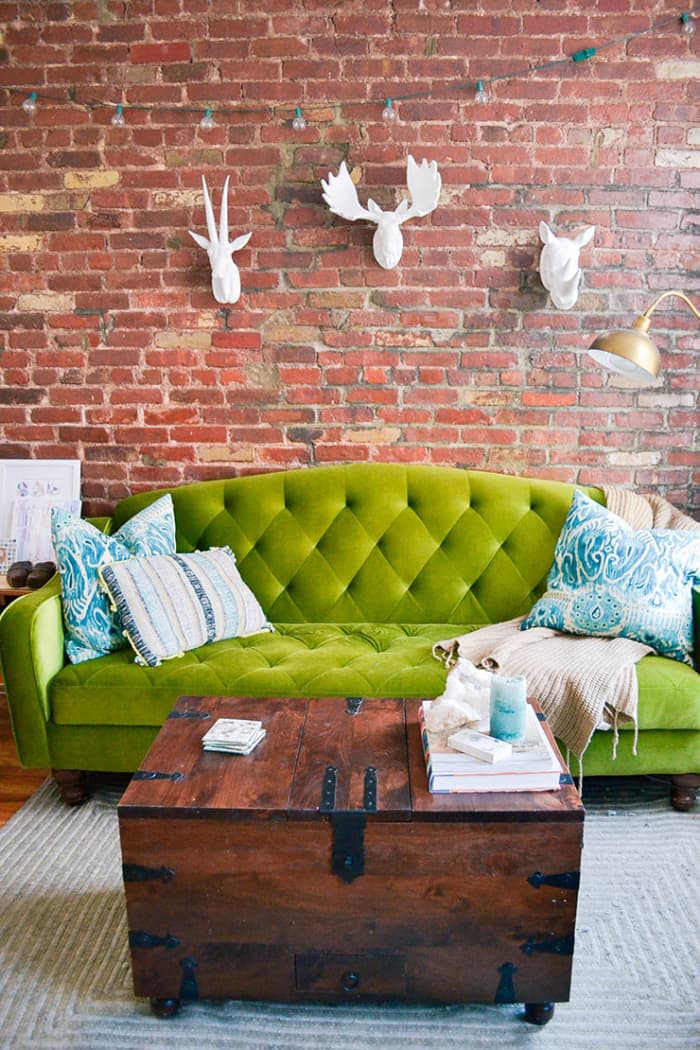
The trunk serves as a coffee table and storage piece while adding a funky vintage touch to the living room.

The trunk serves as a coffee table and storage piece while adding a funky vintage touch to the living room.

1. Select Furniture to Fit the Existing Space

  • Determine Scale and Configuration

When you're working with a compact living room, large-scale furniture often isn't an option. Be realistic about the space. For example, if an oversized recliner won't fit, choose a pair of smaller chairs. Many people also get hung up on common furniture configurations. For example, nothing says that you need a full-sized sofa in your living room. A love seat paired with a bench and an armchair may work more naturally in your space.

  • Think Multifunctional

Choosing multifunctional pieces will also make the most of your living room. For example, a bench with storage will provide seating while housing pillows and blankets. A coffee table or console table makes a great addition to a living room but only when it makes sense for the space. Your small living room may be better suited for two small tables that open up the space and can be moved as needed to accommodate different functions.

  • Consider Floating Furniture and Low Seating

Floating furniture and low seating can make all the difference when it comes to keeping the space open and flowing. Design a floating furniture arrangement in the center of the room instead of pushing pieces up against the walls. Install shelves and other built-in components off the floor to create the illusion of space. If you choose low seating, select pieces that don't distract from the focal statement in the room. For example, a pair of low stools in front of the mantel will keep the fireplace as the focus of the living room.

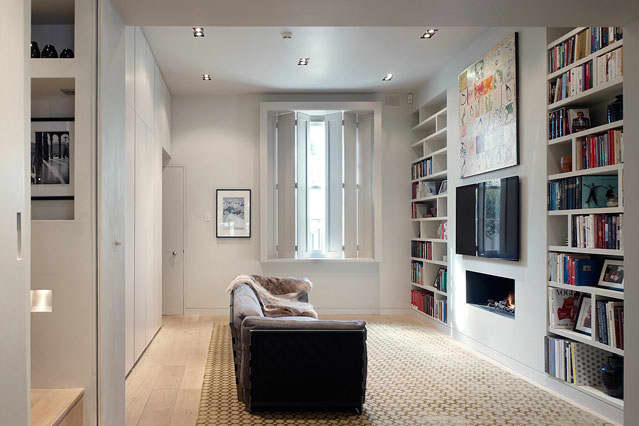
The wall length built-in keeps this narrow living room streamlined and clutter free.

The wall length built-in keeps this narrow living room streamlined and clutter free.

Concealed storage is a great way to house items in the living room without creating a cluttered space. Furniture pieces that boast concealed storage, such as an ottoman with built-in storage, are a great option. You may also want to consider decor pieces that do double duty as storage, such as colorful baskets or jars. Do you have a hard time finding concealed storage pieces that don't take up a ton of floor space? Think about biting the bullet and devoting a single wall to built-in storage. To further streamline the storage, keep your items in the built-in hidden behind doors or curtains.

Read More From Dengarden

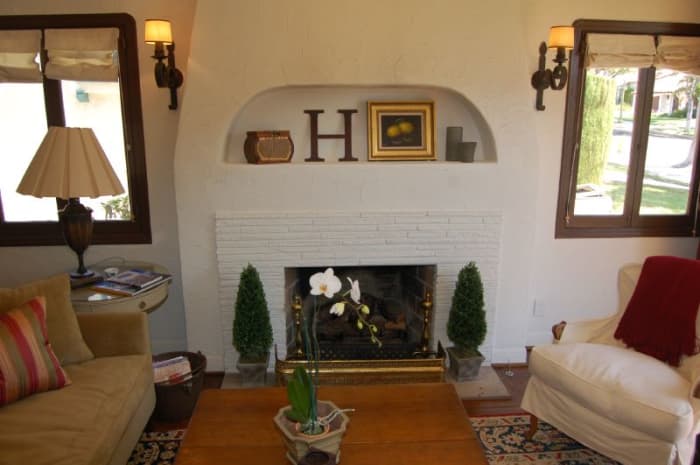
The living room layout showcases the focal fireplace and mantel.

The living room layout showcases the focal fireplace and mantel.

3. Create a Focal Point

A focal point is ideal for drawing people into a space while making it more uplifting and even sophisticated. Think about focusing your living room around a fireplace, sofa, coffee table, artwork, or mirror. Once you've settled on your focal point, design the rest of the living room around your statement piece to pull the entire look together.

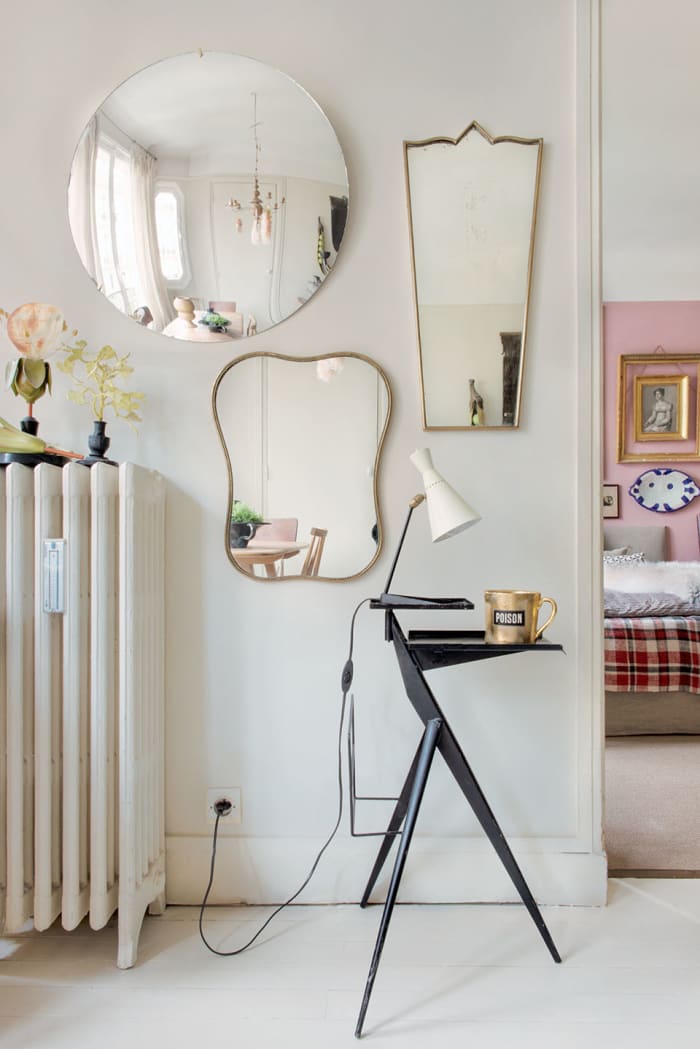
The mirrors reflect the whole space, making it appear larger, while bringing more natural light into the room.

The mirrors reflect the whole space, making it appear larger, while bringing more natural light into the room.

4. Add Light and Depth

Small living rooms with flat features and dark corners look dreary, even when they boast unique furniture and wall hangings. Maximize the natural light in the room, and don't be afraid to add artificial light sources as well. You'll bring even more light and depth into your compact living room with wallpaper and strategically placed mirrors and plants. Purely decorative mirrors still pack a visual punch and draw extra light into the space.

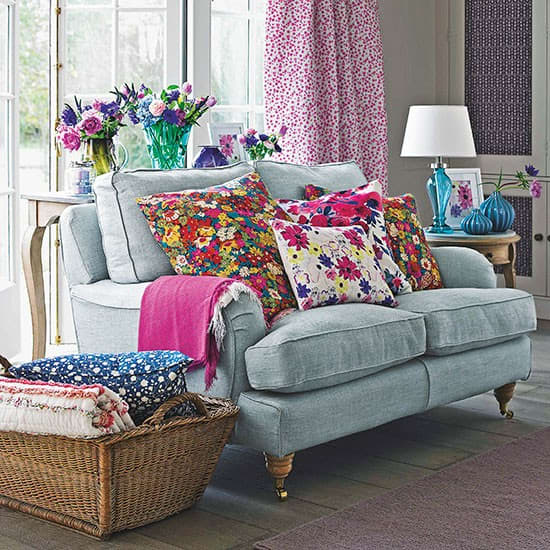
The floral theme ties the colored items in the room together.

The floral theme ties the colored items in the room together.

5. Don't Be Afraid of Color

Many people steer clear of color in small living rooms, believing that it will overwhelm the space. While there is nothing wrong with designing a small living room that features neutral shades, color can make the space appear larger. Select a color scheme with a maximum of three shades to create a unified aesthetic. If you want to use additional colors, incorporate them as accents. Typically lighter shades make a space look larger, but careful use of darker shades takes the style and drama in the room up a notch.

When you paint a small living room, select a satin or semigloss finish to reflect the light. If you want to tie the color scheme in the room together without painting or buying new furniture, consider an area rug. Layer a rug over carpeting to make the room feel cozier or conceal dark flooring with a brightly colored rug to lighten up a dark space.

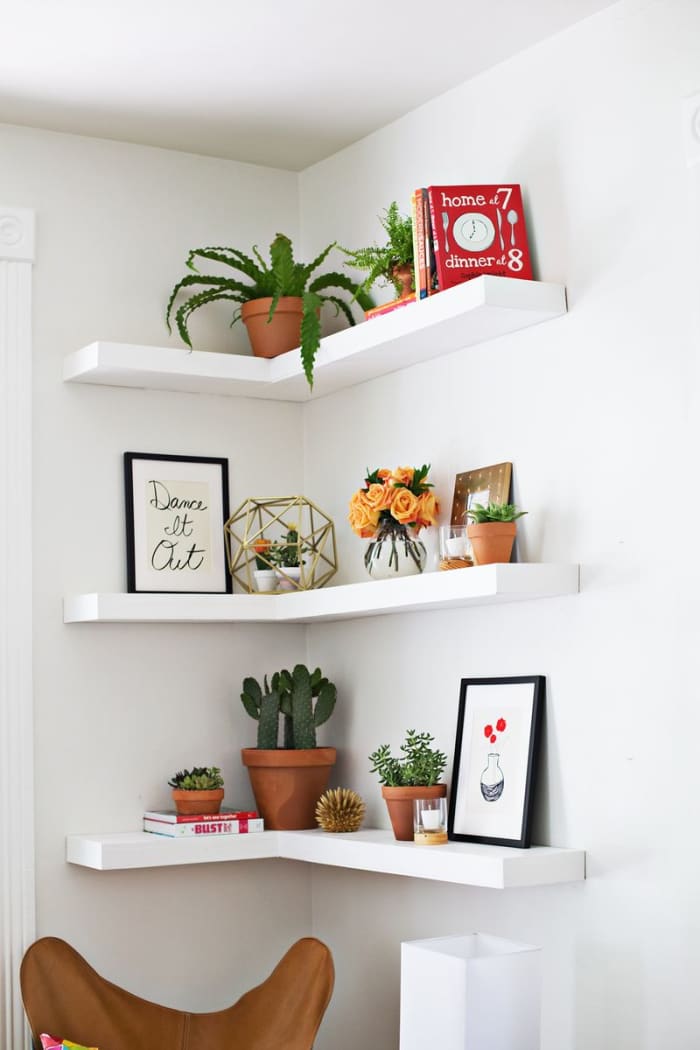
This set of floating shelves draw the eye up while adding room for knick knacks in otherwise wasted corner space.

This set of floating shelves draw the eye up while adding room for knick knacks in otherwise wasted corner space.

6. Take Advantage of Vertical Space

Build up instead of out to maximize the available space. When you hang curtains, place the curtain rods right below the ceiling. Then choose curtains that extend all the way to the floor to make the ceiling look higher. If you're selecting art or other wall hangings, consider designing a gallery wall or choosing a few large pieces that fill the whole space. Do you have an odd nook that currently serves little or no purpose in the living room? Think about constructing shelves to simultaneously add storage and draw the eye upward.

Small Family Room Design

Finally, creating the ideal flow for your small living room is an ongoing process. It often takes weeks, or even months, of living with a living room arrangement to determine what is and isn't working. Don't be afraid to keep making tweaks and adjusting the layout until you find a arrangement that suits you and your family.

Additional Small Home Resources

  • Frugal Storage Ideas for Small Homes: Creative, Unique Organization Methods
    Creating functional storage for a small home is simple when you're equipped with the right organizational tools. Pick up purchasing resources, general organization tips, and much more.
  • How to Make the Most of a Small Kitchen: Simple, Affordable Kitchen Solutions for Every Budget
    Organize and brighten up your small kitchen space with practical solutions to create a functional yet inviting space for family and friends.

© 2016 Rose Clearfield

Riffat Junaid on June 30, 2020:

Very good article you wrote very helpful tips and pictures are so beautiful you added.

Chitrangada Sharan from New Delhi, India on April 05, 2016:

Excellent hub!

I enjoyed going through your tips and suggestions to design and lay out a small living room. Using the place below staircase is a very nice idea. Very attractive pictures to complement your interesting and useful hub.

Thanks for sharing!

Living Room Storage Console

Source: https://dengarden.com/interior-design/How-to-Design-and-Lay-Out-a-Small-Living-Room

Share:
 
banner